
Post-Crisis to Assemblage Poetics
Annulet’s folio topic on the history of American poetry and poetics from 2008 to the present maps well onto the whole of my activity to date as a poet, editor, and theorist, including my naming of “post-crisis poetics” that raised the folio’s periodizing concern in 2013 through emphasizing the 2008 economic crisis. I will reconstruct contexts for my formulation of post-crisis poetics and its extensions to date through my current concept, “assemblage poetics.”
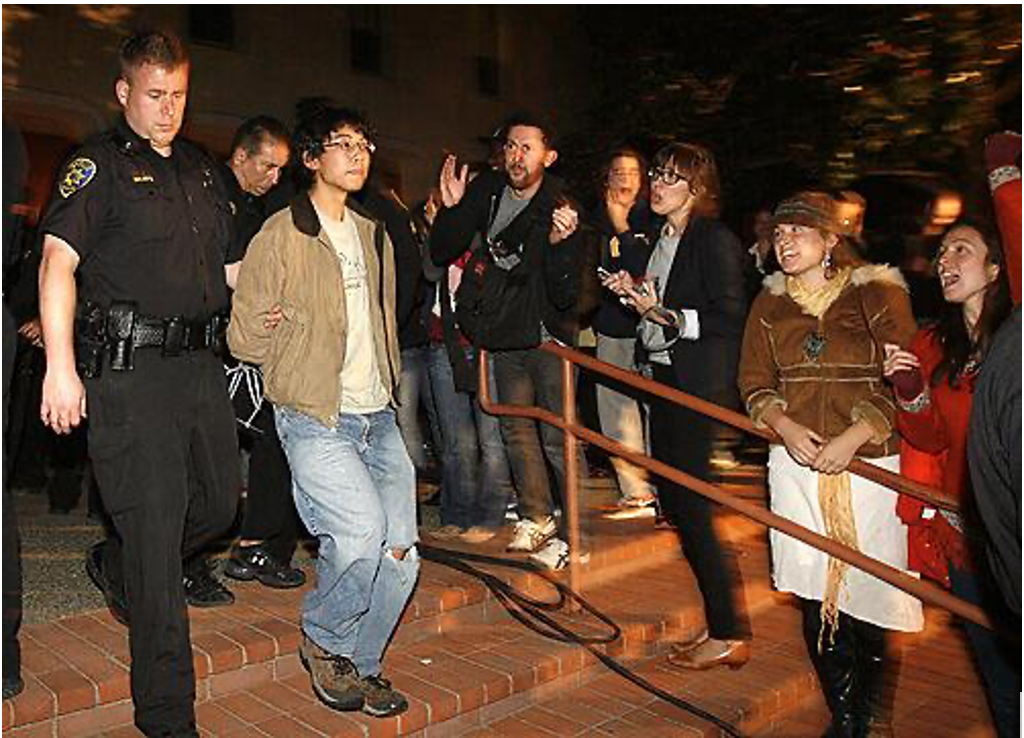
“Brian Ang is led out from Mrak Hall after being arrested during a protest Nov. 19, 2009.” Photo by Fred Gladdis for The Davis Enterprise.
After starting to write poetry at the University of California, Davis in 2006 as an undergraduate, I entered the Master of Arts Program for Creative Writing in Poetry there in 2008. The 2008 economic crisis and participating in the California anti-austerity university struggles that began in 2009, the first significant resistance to the crisis in the United States, influenced my studies in political theory introduced through experimental poetry that aimed toward immediate practice. [1] These struggles influenced politicized poetry projects including the 95 Cent Skool: Summer Seminar in Social Poetics in 2010 and the Durruti Free Skool in 2011, both organized by Joshua Clover and Juliana Spahr in the San Francisco Bay Area concerning poetry and social struggle, and my magazine ARMED CELL launched at the Durruti Free Skool. [2]
ARMED CELL
My decision to publish a magazine was influenced by both historical and contemporary ones. From studying literary history, I understood This and L=A=N=G=U=A=G=E’s significance in connecting writers toward constructing Language writing’s radical poetics; Barrett Watten gave me rare copies of This at the Alphabet: A Symposium on Ron Silliman’s Long Poem in 2011 and L=A=N=G=U=A=G=E was available online through Craig Dworkin’s Eclipse archive, enabling me to study their editings. I started participating in the San Francisco Bay Area poetry community in 2008 and published in its magazines Try! and With + Stand; I experienced how they were constitutive of the community including through distributions of free issues at readings, With + Stand’s also shared online. Lana Turner: A Journal of Poetry and Opinion launched in 2008 fulfilling the role of a large journal publishing politicized poetry and essays, which reinforced my decision to publish a little magazine. [3] From these influences I decided that ARMED CELL would be free, published both in print for the significance of physical distribution and online in order to be available to all, open to submissions, and aimed toward constructing a new radical poetics.
In planning my magazine, I drew its values from the California university struggles, the 95 Cent Skool, and the Durruti Free Skool. The California university struggles had been repressed through 2010 and participants were trying to continue and extend the struggles through anti-austerity actions in Oakland; against repression in the streets, I wanted a creative project for extended investigation. I drew ARMED CELL’s title from a desire for militant intransigence signified by that form of struggle and solicited people I thought resonant with these values with a statement:
ARMED CELL seeks to publish what is urgent and necessary in poetry and poetics. It insists on militancy “working for the emancipation of humanity in its entirety” (Alain Badiou) to confront the notion of there being at present “too much anti-capitalism” (Slavoj Žižek) and not enough direct action against “capitalism (or whatever other name we might want to give to the process dominating world history today)” (Giorgio Agamben). ARMED CELL seeks relationship with those engaged in research and practice with this matrix of concerns, in order to be, like Lenin’s pre-revolution withdrawal to study Hegel, a site for the study necessary for executing political actions. [4]

ARMED CELL 1, ed. Brian Ang (2011), contents.
The statement was included in ARMED CELL 1 against fence-sitting, esthetic and political. The resulting contributors were David Lau, Jeanine Webb, Roger Farr, Dereck Clemons, Ara Shirinyan, Wendy Trevino, Dan Thomas-Glass, and me, with cover images by Paul Chan; ARMED CELL 1 set characteristics for subsequent issues. ARMED CELL would publish many contributors from California and especially the San Francisco Bay Area where Chan, Clemons, Thomas-Glass, Trevino, and I lived, with Lau in Santa Cruz, Shirinyan in Los Angeles, and Webb in San Diego; ARMED CELL would also publish many writers from Vancouver, where Farr lived, Farr’s inclusion emblematic of the groups from Vancouver that participated in the 95 Cent Skool and the Durruti Free Skool. ARMED CELL would be published biannually in a physical edition of one hundred and online, first distributed at specific events to extend connections there from a desire to “find each other.” ARMED CELL 1’s eight writers in forty-two pages established the magazine’s approximate length, subsequent issues ranging from six to eight writers in thirty-four to forty-six pages. [5]
I first heard David Lau’s poems that I published in ARMED CELL 1 at a reading that I organized the previous year for him and Jasper Bernes and requested them for the issue; I chose Lau’s “Communism Today” as the issue’s first poem for taking the California university struggles as its context, the issue’s first page containing the poem’s first of four sections:
Call-in request line binding force
cut back, fought
with Mozart and the percussion great
called Non-Los Angeles.
They came around the
building with our comrades
in front of them as shields.
Fuck Dave Kliger.
Which one of these anarchist faggots stole my SIM card?
See if the janitor has the key to open these doors.
He’s the person we need everything.
The telos today closer to undead,
insurrectionary Velazquezes incapable
of enduring independent labor monitors—wild Mike is
straight up drugs. Sri Lankan and
subjective confusions
adopted that language
as in Balzac when rude boys
had rivers to cross.
A snort of laughter to knot
en El Encanto Sanitarium
near the freeway river flowing 100,000 stanzas,
let Placitas bloom 1,000 at a time
quickly into inauspicious jobs.
Occupy everything, including Humanities
The poem assembles references to art, history, literature, and music with senses and particulars from the California university struggles; against an absent future of inauspicious jobs after the 2008 economic crisis emerged the struggles’ slogan “Occupy everything” calling for “the immediate formation of ‘communes,’ of zones of activity removed from exchange, money, compulsory labor, and the impersonal domination of the commodity form” which the poem emphasizes “including Humanities” calling for the communization of their knowledges toward immediate struggles: “Communism Today.” I saw “Communism Today” as emblematic of my editing of ARMED CELL, assembling practices articulating senses, particulars, and forms emerging after the 2008 economic crisis toward extrapoetic political action. [6]
My thoughts on connections between poetry and politics influencing my editing at this time are in my piece “Poetry and Militancy”:
The present state of the social text, with its political climate of the post-2008 market crash’s systemic re-exposure of capitalism’s brutality at the level of everyday life and resultant re-ignition of political imagination and praxis for the efficacy of activism, calls for a greater insistence on poetry to contribute to militancy. By militancy, I mean activism that thinks toward the furthest limits in challenging the social text for the emancipation of humanity in its entirety, and executes actions as necessary toward this goal, often requiring strikes, occupations, and riots…As the social text constantly develops, avant-garde techniques are important for their novel utilities in engaging the text. “Poetry is not Enough.” [7]
Avant-garde poetics is called on to support militant politics, poetry being not enough without political action. I first presented “Poetry and Militancy” at the Poetic Labor Project’s *** WORKING *** WRITING *** FIGHTING ***: A Gathering on Labor, Art & Politics on Labor Day weekend 2011 at the Niebyl-Proctor Marxist Library in Oakland, organized by David Brazil, Brandon Brown, Sara Larsen, Suzanne Stein, and Alli Warren, its second gathering following one on Labor Day weekend 2010. [8]
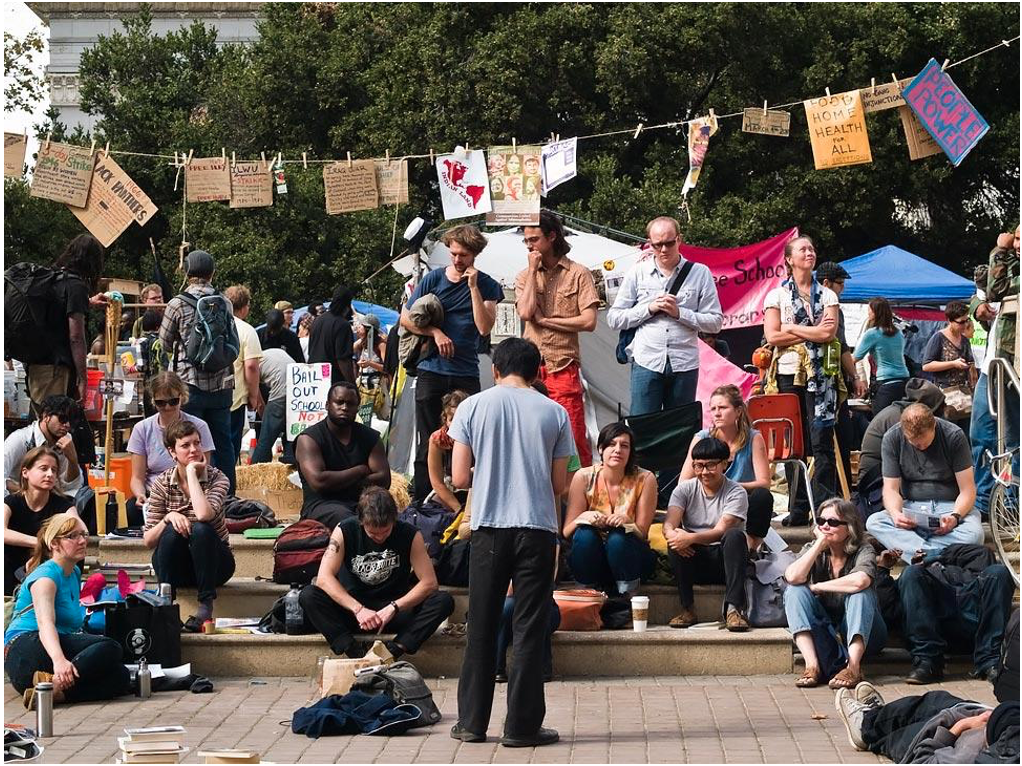
Occupy Oakland poetry reading, October 16th, 2011; Brian Ang reading David Lau. Photo by Andrew Kenower.
Later that month, the Occupy Wall Street movement began in New York City, influenced by communities, knowledges, and actions from the California university struggles, transforming “Communism Today”’s slogan “Occupy everything,” preserved in its emergence, from obscure to popular significance. [9] Politicized poetry projects including the 95 Cent Skool, the Durruti Free Skool, ARMED CELL, and the Poetic Labor Project were constitutive of the San Francisco Bay Area poetry community participating in Occupy Oakland. [10] Drawing connections between the 95 Cent Skool, the Durruti Free Skool, and Occupy Oakland, Roger Farr edited a collection for The Capilano Review consisting of me, Jasper Bernes, David Buuck, Melissa Mack, Wendy Trevino, and Jeanine Webb:
I have collected work by some of the Bay Area-based writers I met at the gatherings and whose work I admire. While I would not want to make the reductivist claim that the work in this section elaborates or represents the concerns that surfaced over the course of the two assemblies, it is worth noting that many of the Bay Area participants and organizers later became active in the Oakland Commune, a “zone of opacity” that completely blew up—in a good way—during the Occupy Wall Street actions of 2011. Certainly, that historical moment—“the first of many last resorts”—materializes here. [11]
With the Occupy movement underway, ARMED CELL 2 made connections with New York City writing through publishing Josef Kaplan and Laura Elrick, first distributed at a reading I gave there with them. [12] ARMED CELL would go on to publish many contributors from New York City, joining the San Francisco Bay Area and Vancouver as ARMED CELL’s most consistent sources of contributors. Contributors were drawn from connections made at events where ARMED CELL was first distributed and other events that I participated in especially in these places. [13] ARMED CELL 3 connected with Language writing through publishing Lyn Hejinian; ARMED CELL 4 connected with United Kingdom writing through publishing Joe Luna. [14] My contributions in issues one through four were mostly critical pieces: “Textuality and Annihilation: Joshua Clover’s ‘Gilded Age’”; “From Pre-Symbolic to Totality: On Method” and “Totality Canto 8,” my first presentation from my poem The Totality Cantos; “Language Writing and the Present,” on Language writing and Conceptual writing; and on Kaplan’s book Democracy is not for the People. [15]
Post-Crisis Poetics
For ARMED CELL 5 I wrote about David Lau’s “Communism Today” which led to my first naming and defining of post-crisis poetics: “post-crisis poetics organizes materials that could be useful for immediate struggles and in combination with materials to be produced in the struggles to come.” [16] The Occupy movement had been repressed through 2012; I wanted a poetics for investigating what post-crisis struggles including the Occupy movement were revealing about what could be useful for both immediate and future struggles within indefinitely continuing post-crisis conditions, as knowledge from the California university struggles had been useful in the Occupy movement. [17] The statement that had been in issues one through four was revised in ARMED CELL 5, the magazine adequately constituted by its contents without specific theorists: “ARMED CELL seeks to publish urgent and necessary poetry and poetics: materials for political action.” The statement would disappear in subsequent issues, post-crisis poetics implicitly replacing it. My contributing critical pieces in each issue stopped in order to focus on developing post-crisis poetics.
I began developing post-crisis poetics that year in “Assembling ARMED CELL: Post-Crisis Poetics,” presented at “Learning from Oakland: Occupy Poetics,” organized by Barrett Watten, at the Association for the Study of the Arts of the Present’s Arts of the City conference, analyzing David Lau’s “Communism Today” and Josef Kaplan’s “Ex Machina,” the first poem in ARMED CELL 2. [18] I developed post-crisis poetics further through presenting it at the Militant Research Collective’s meeting at the International Association for Visual Culture and the San Francisco Museum of Modern Art’s Visual Activism symposium in 2014, invited by Nicholas Mirzoeff. [19]
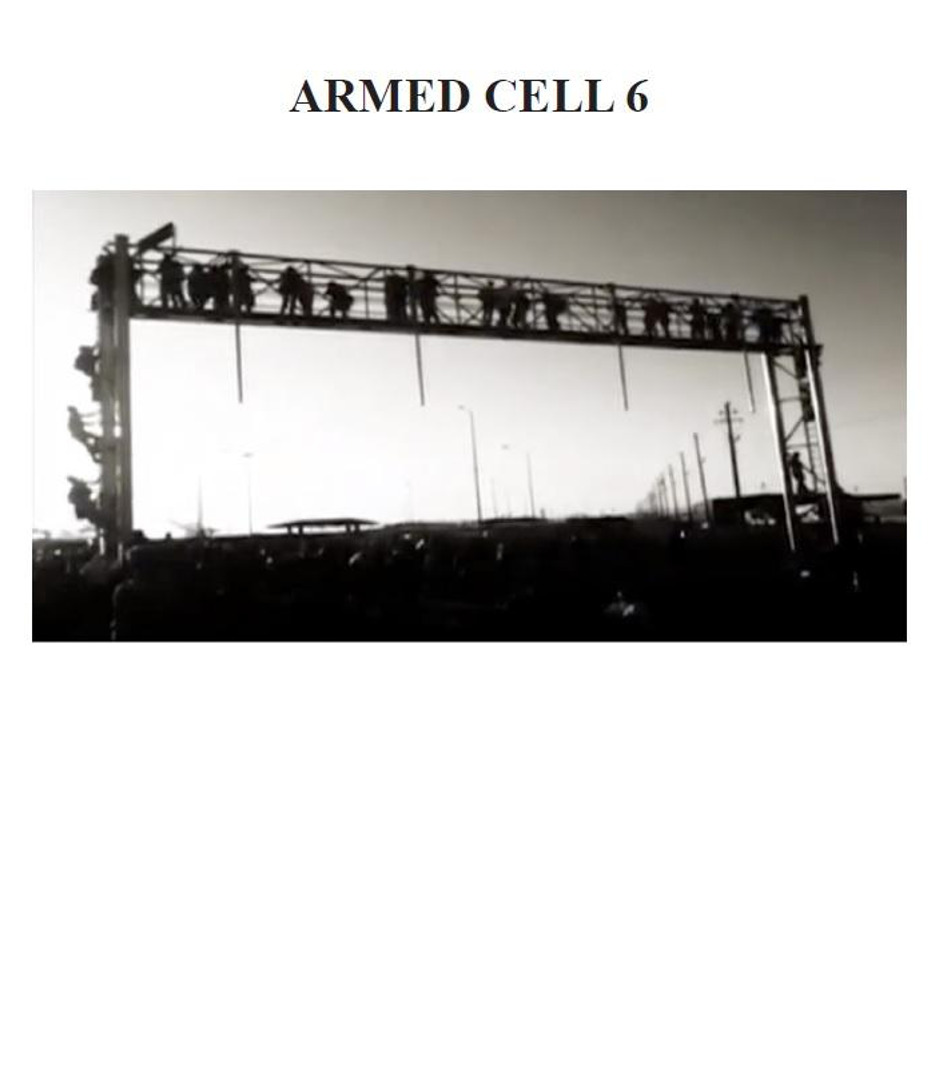
ARMED CELL 6, ed. Brian Ang (2014), cover
Referencing my “Post-Crisis Poetics: David Lau’s ‘Communism Today’” piece, Barrett Watten drew connections between Language writing and the Occupy movement and analyzed me and Lau:
It is important that Occupy Oakland was the third moment in a series of political uprisings in the Bay Area, beginning with street protests of the killing of a young black man, Oscar Grant, on public transit in 2009, and continuing through the demonstrations at University of California campuses, protesting cutbacks and tuition hikes…It is equally the decades-long radicalization of Bay Area poetry that led it to develop a principled relation to Occupy politics, marked by its construction of ad hoc social networks as much as “radical formal means”: the privileging of house readings over institutional programs; the proliferation of microscopic presses and online zines in addition to established small presses; the conjunction of writings in poetics with theoretical politics; and the development of The Public School and later The Omni, alternative educational sites that decenter and pluralize public education…Contrasted to the public and populist aims of the Occupy Wall Street Poetry Anthology, Ang’s journal is the quintessence of micropolitics...ARMED CELL is thus, first and foremost, a blueprint for the survival of a community of organic intellectuals who will give their talents to the coming insurrection, outside the university system, even as the event of these politics has always already arrived and been deferred…The central question of [“Communism Today”], then, is the relation of negative materials to positive freedom, what one experiences of the alienated lifeworld versus a poetic capacity to reconstitute it. [20]
I had published Watten in ARMED CELL 6, including his note on his reading at my apartment “between collective readings of The Grand Piano at UC Berkeley and Small Press Traffic in San Francisco” in November 2011 during the Occupy movement. The specter of the repressed Occupy movement is manifest in ARMED CELL 6, as in its cover art by Mayakov+sky from Occupy Oakland’s November 2nd, 2011 general strike and port shutdown, a high-water mark of the Occupy movement, and Jasper Bernes’ work from We Are Nothing and So Can You that begins the issue immediately preceding Watten’s, which projects a post-revolutionary horizon from post-crisis experiments with communism as a process, the formation of zones removed from capitalist exchange in the occupations of universities to city squares, including the Occupy movement. [21]
Writing against Conceptual writing as the avant-garde, David Lau referenced post-crisis poetics to propose and connect emergent global avant-gardes from Russia to the United Kingdom to California:
But there is also some new song (that old bad thing) slouching out of the megacity today, a left political aesthetic development forged in the crucible of perilous circumstance, one distinct from conceptual writing and the digital curatorial practices I’ve described above. Today another sort of avant-garde poetry is emerging, steeled in post-financial crisis anti-austerity struggles, like those in 2009 that preceded Occupy on UC campuses and other parts of the public sector, but one that is also global in reach, a “post-crisis poetics,” as Brian Ang calls it: from Moscow’s Kirill Medvedev, and the young Pavel Arsenev in Saint Petersburg’s poetry and activist video scene; to the radical poets of London and the UK, Sean Bonney among them; and to those working this vein in the rock here in California, where Lyn Hejinian has identified an activist poetic avant-garde’s emergence in the Bay Area. A social poesis cuts across my examples here, a practice that takes the form of an insurrectionary poem, an upstart or residually Marxist publication, a poster slogan, a roared chant, or an activist video of a “sick” demo. Partly informed by a neo-orthodox Marxist economic and historical perspective, or even just a loose metaphorical atmosphere of far left anti-capitalism available on social media platforms, there’s a concomitant online magazine and editorial dimension at work today. A new crop of magazines and journals in on the act does some of the work of careful and discriminating selection, keeping all the erasers in order. [22]
My editing approach toward constructing a new radical poetics included engaging prior and existing avant-garde poetics, including Language writing and Conceptual writing as these poetics also did, both through publishing their practitioners and writing influenced by them; in addition to publishing Hejinian in ARMED CELL 3 and Watten in ARMED CELL 6, I published Kenneth Goldsmith in ARMED CELL 7 and Bruce Andrews in ARMED CELL 8. [23] I chose first poems in each issue to emphasize them for a new poetics.
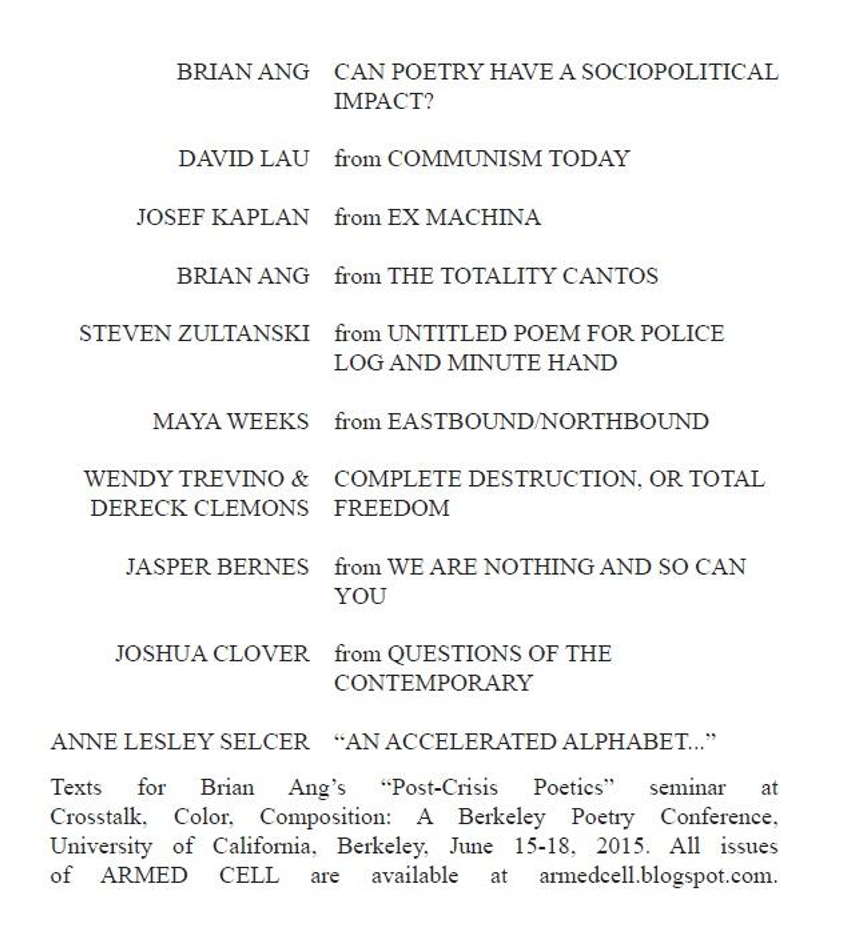
“Post-Crisis Poetics seminar texts,” ed. Brian Ang (2015), for Crosstalk, Color, Composition: A Berkeley Poetry Conference.
Responding to Jacket2’s Quick Question series, which asked “Can poetry have a socio-political impact?” developed my thinking on post-crisis poetics further: “In a forthcoming essay, ‘Post-Crisis Poetics,’ I connect readings of poetries that I’ve published in my magazine ARMED CELL…The project of post-crisis poetics is the constituting of a community for searching out historical conditions, sociopolitical desires, and adequate forms of struggle in the period’s unfolding transformations to come.” [24] Later that year, the Berkeley Poetry Conference 2015 at UC Berkeley, “conceived as a 50-year celebration of the Berkeley Poetry Conference that took place in 1965,” was cancelled “due to many of the invited speakers pulling out in protest of the presence of Vanessa Place (although others cancelled for various reasons).” [25] The conference was reorganized as Crosstalk, Color, Composition: A Berkeley Poetry Conference, “a new multi-day event around readings given by and seminars led by several poets of color of national reputation.” [26] Lyn Hejinian invited me to participate and I presented the conference’s final seminar on “Post-Crisis Poetics”: “Discussion will concern the post-crisis poetics concept, the seminar poetries, and further perspectives about what poetry and poetics contribute or could contribute to critically thinking about the post-crisis period in progress, including connections with participants’ works.” [27] My seminar texts were my response to “Can poetry have a socio-political impact?” and poems by David Lau, Josef Kaplan, me, Steven Zultanski, Maya Weeks, Wendy Trevino and Dereck Clemons, Jasper Bernes, Joshua Clover, and Anne Lesley Selcer, the first poems in all of ARMED CELL issues at that time, one through eight, and my work in ARMED CELL 2. [28] In my seminar I “improvised an elaboration of the post-crisis poetics concept through shuttling among the levels of the economic, the 2008 crisis and periodizings of [Fredric] Jameson, [Giovanni] Arrighi, and [Robert] Brenner; the political, post-crisis struggles including the 2009 California university movement, the Arab Spring, the Wisconsin occupation, Occupy, and Black Lives Matter; and the poetic, thoughts on an historicized critical poetics.” [29]
Heriberto Yépez published both a polemical report of the conference including of my seminar and a post-conference report:
Ang makes a very good presentation from a mostly traditional Marxist perspective, which comes with its Eurocentric teleology. My traditional Marxist training prepares me to agree with this framework and I find myself fighting my embodiment of that training. And the audience increasingly disagrees with Ang’s Marxism. The whole morning Marxism was a no-no to the audience…Ang insists poets should be militants. He characterizes the former insurgent model as the poet who formulates messianic utterances. He exemplifies this anachronistic model in Ginsberg’s “I declare the end of the War!” referring to Vietnam in his “Wichita Vortex Sutra.” Ang declares this model is over. He insists David Lau’s “Occupy everything, including Humanities,” (that influenced the Occupy movement) as a sign of the new program. [30]
Additionally, he wrote: “The consequences of everything taking place in North American poetry and the event to celebrate the 50th anniversary of the Berkeley Poetry Conference have sealed two undeniable facts: 1) a cycle of North American poetry officially ended in 2015 and 2) the new North American poetry will be more and more dominated by non-white poets.” [31]
After publishing ARMED CELL 9, Jeff Derksen and I convened a seminar called “Post-Crisis Militant Word” for the Poetics: (The Next) 25 Years conference at the University at Buffalo:
This seminar combines two critical poetics perspectives on the present: Brian Ang’s “Post-Crisis Poetics” and Jeff Derksen’s “The Militant Word.” “The Militant Word” inquires into the plurality of militant poetries present and past, while “Post-Crisis Poetics” concerns critical poetries since the 2008 economic crisis, with a perspective toward transformations over “the next 25 years” and beyond. Discussion seeks further perspectives from participants in order to exchange awarenesses and multiply connections with their own practices. [32]
The seminar’s participants were alex cruse, Ian Davidson, Helen Dimos, Brenda Iijima, Nicholas Komodore, David Lau, Thomas Marshall, Andrew McEwan, Ryan Sheldon, Christine Stewart, Fred Wah, and Jeanine Webb; cruse, Komodore, Lau, and Webb were contributors to ARMED CELL. [33] I first distributed ARMED CELL 10 at the conference, which begins with my piece “Post-Crisis Poetics”:
Post-crisis poetics: desire for a poetics adequate to the present, the world since the 2008 economic crisis…What I want is to connect practices into a dynamic stance toward the present in order to lead to a new poetics adequate to the post-crisis period in progress…Post-crisis poetics: construction of a network of practices adequate to writing the present, the post-crisis period in progress. Toward its construction, I’ve analyzed practices investigating multiple dimensions of the post-crisis world-system, suggesting lines for multiplying the communization of knowledge within the unfolding present. [34]
I analyzed practices by David Lau, Josef Kaplan, me, Steven Zultanski, Maya Weeks, Wendy Trevino and Dereck Clemons, Jasper Bernes, Joshua Clover, Anne Lesley Selcer, and Rob Halpern, the first poems in ARMED CELL’s issues one through nine and my work in ARMED CELL 2:
Against such an absent future emerged the university struggles’ slogan “Occupy Everything” calling for the immediate formation of communes, which the poem extends “including Humanities” against reformist calls to “Save the Humanities,” the communization of knowledge aimed at in “Communism Today” emblematic of post-crisis poetics’ project variously extended in the following practices…Beyond the specific, “Ex Machina” confronts the uncertain redemption of political violence and estranges its symbolization in culture and history for active construction…The Totality Cantos is assembled from a desire for more totalizing signifying possibilities adequate to investigating post-crisis reality…After the Occupy movement’s inadequate resistance to the police, the police’s violent repression of the movement, and the movement’s inability to reestablish the occupations on May Day, “Untitled Poem for Police Log and Minute Hand” conceptualizes the governmentality of police power in daily life so that it can be continuously resisted and the system that the police preserve can be changed… “Eastbound/Northbound” maps ideology’s continuous neutralization, complementary to and made more legible by the Occupy movement’s repression, so that it can be continuously resisted and overcome in future movements…Such decentralized organizing brought together the mass mobilizations in the post-crisis cycle of struggles from Cairo to Montreal, empowering collective direct actions envisioning the “COMPLETE DESTRUCTION” of intersecting systems of exploitation and oppression and the horizons for “TOTAL FREEDOM” beyond them…We Are Nothing and So Can You’s envisioning of a possible future reflects the limits and prospects of the post-crisis present, making them more legible to navigate…“Questions of the Contemporary” inquires into capital’s post-crisis dynamics, the reasons why “things keep on,” for where to intervene…In the post-crisis period of exacerbated unemployment, the figure of a child born into the present yet prior to meaning is traced as a subject, singing against empire’s neutralization with an infinitizing of what is…“Hoc Est Corpus” orients one’s body in a relation of care toward the detainee as paradigmatic of socially negated bodies in order to imagine such relations that a non-repressive future depends on and make felt the state’s epistemological and penal apparatuses that block their emergence and need to be destroyed. [35]
I closed with an invitation to readers “[t]o continue construction and encourage discussion” for “views of what writing can contribute to further investigating the post-crisis present for a series that I’m editing to be published over the course of a month.” [36]
Later that month, Sean Bonney began his graduate course on “Post-Crisis Poetics” at the Freie Universität Berlin with this description:
The ongoing crises following the 2008 financial crash have had a profound effect on questions relating to American avant-garde and experimental poetics, just as they have on most other areas of public and private life. Since the 1970s the primary focus of politically engaged radical poets, most famously those associated with the L=A=N=G=U=A=G=E movement, had been formal and syntactical questions, leading to a hermetic poetics that favoured textual fetishism over social engagement, with the assumption that a radical aesthetics always implied a radical political commitment. For a younger generation such assumptions have begun to seem insufficient, if not downright false: questions of content have gained more importance, and in particular how to use that content without sacrificing the syntactical and textual complexity that have always characterized avant-garde poetics. [37]
Leading up to the Post-Crisis Poetics series, I published ARMED CELL 11 and participated in a conversation about post-crisis poetics with Caleb Beckwith:
Developing this poetics through editing and analyzing writing led me to clarify that what “could be useful” for struggles is knowledge of the post-crisis world-system that struggles confront. Post-crisis poetics connects a network of practices investigating multiple dimensions of the post-crisis world-system in order to suggest extensions in every direction…Connecting each piece in post-crisis poetics’ network adds more practices and further investigates more dimensions of the post-crisis world-system, constructing a common sense of the post-crisis present opening possibilities for the communization of different kinds of knowledge and for different groups to come together. [38]
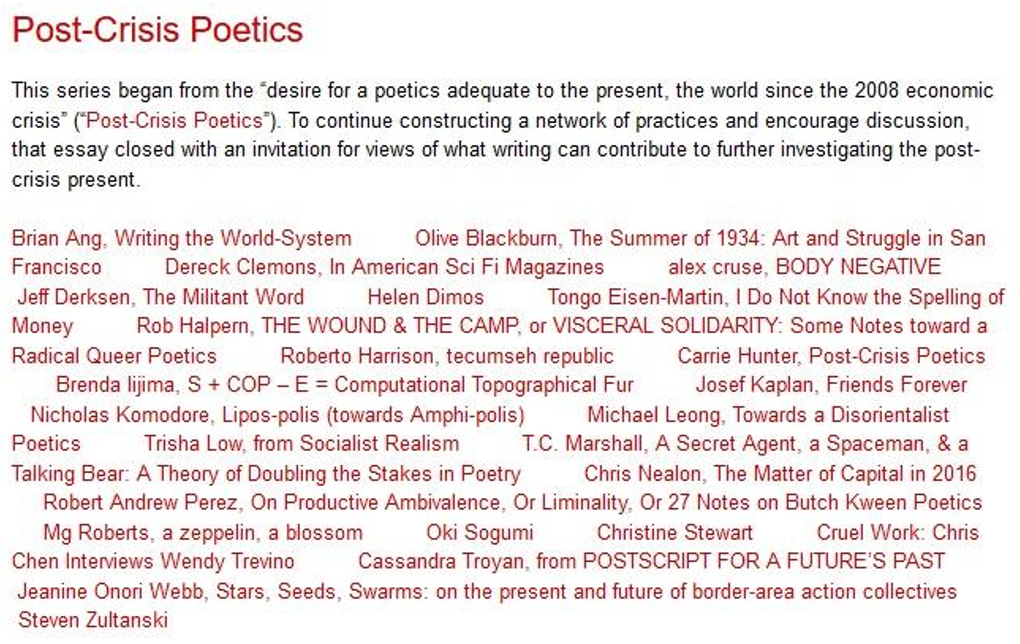
Post-Crisis Poetics series, ed. Brian Ang (2017).
The Post-Crisis Poetics series was serialized a piece per day in alphabetical order through April 2017 and consisted of twenty-five pieces by me, Olive Blackburn, Dereck Clemons, alex cruse, Jeff Derksen, Helen Dimos, Tongo Eisen-Martin, Rob Halpern, Roberto Harrison, Carrie Hunter, Brenda Iijima, Josef Kaplan, Nicholas Komodore, Michael Leong, Trisha Low, T.C. Marshall, Chris Nealon, Robert Andrew Perez, Mg Roberts, Oki Sogumi, Christine Stewart, Chris Chen and Wendy Trevino, Cassandra Troyan, Jeanine Onori Webb, and Steven Zultanski. [39]
Josef Kaplan’s and Steven Zultanski’s pieces emphasized the heterogeneity of post-crisis poetics:
[ARMED CELL’s poems are] described as responding to the upheavals of the “post-crisis present,” but beyond that characterization they often have very little in common with one another in terms of how they appear as poems. The journal doesn’t serve as a site for one self-evident vision of a “post-crisis poetics,” but for many—coming from many different writers, each coming from distinct networks of other writers operating in different ways, each with their own sympathies, rivalries, and background debates…While unbound by any one particular poetic program, the works in ARMED CELL find their coherence in a general atmosphere of purpose or collective belief, and sometimes even lacking that, simply the fact of some of these writers being close to one another, and supporting each other, and making space in that support for whatever styles of writing might be useful for someone at whatever point in time for whatever reasons. [40]
I’m not 100% sure what you mean by “post-crisis poetics,” but that’s probably because you don’t intend it to have a single reference; I imagine it’s meant to be a suggestively open term designating a general condition (crisis) and a particular stance (anti-capitalist). Personally, I understand the crisis in question as a series of multiple, overlapping, and illusorily permanent crises: the economic crisis (at a macro level the ongoing crisis of the global factory system and mass exploitation, and at a micro level the shocks of financial crises and the profits made off their management), the crisis of patriarchy, the crisis of white supremacy, the crisis of ecological damage and the extinction of species. That’s to say that I understand your term, “post-crisis poetics,” to suggest a condition under which poetry is written—the condition of overlapping crises—rather than an aesthetics or methodology of rendering crisis…I don’t think there’s one way to approach this topic, or a special way, either as a poet or a critic. That doesn’t mean that aesthetics are meaningless, and that questions of form and style are subsumed by the sheer enormity of the crises. It just means that there’s a lot of different ways to figure various crisis-points, resistances, and tangents. Crises are deep and varied, and their effects are inscribed in a wide array of literature. [41]
After publishing ARMED CELL 12 and completing the Post-Crisis Poetics series, I decided to end the magazine to focus on writing The Totality Cantos. ARMED CELL published sixty-five contributors in all. [42]
The Totality Cantos
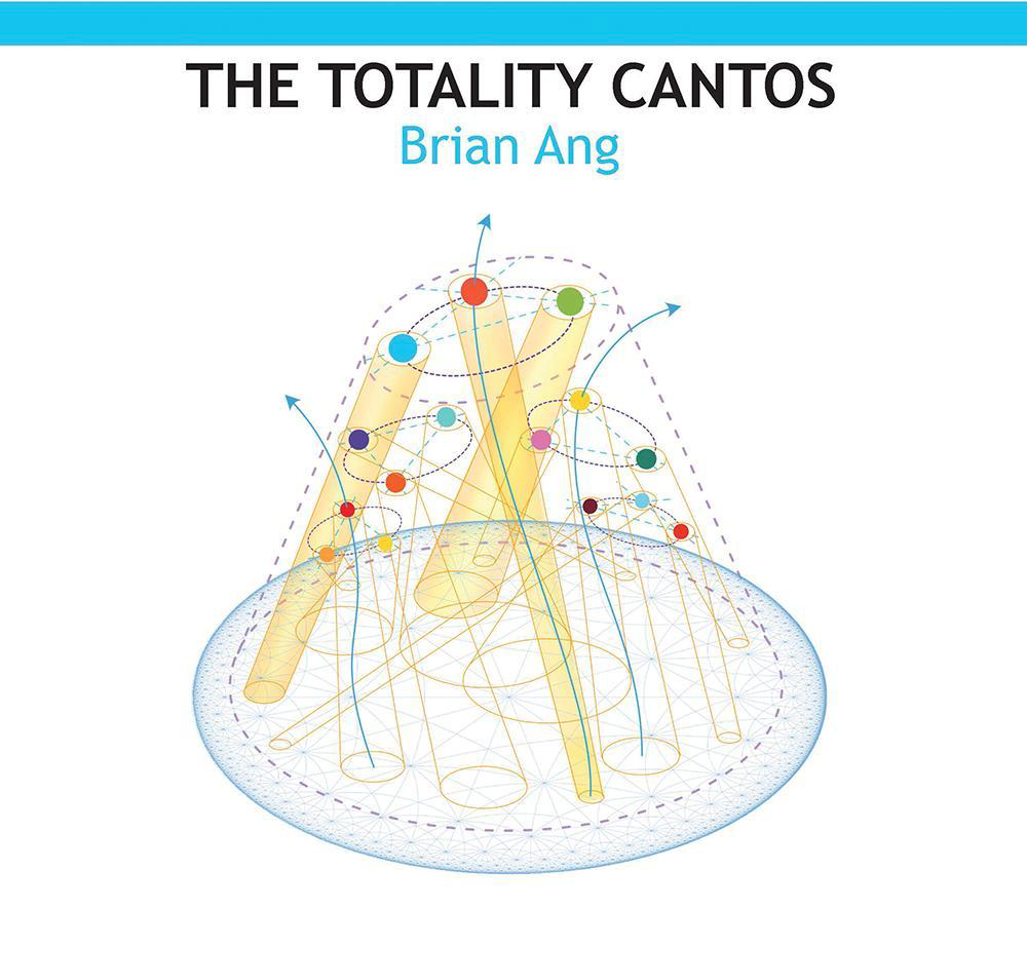
Brian Ang, The Totality Cantos (2022)
I conceived of The Totality Cantos while hearing Joshua Clover’s presentation at the Can Art and Politics Be Thought? conference in 2011:
The epic is the poem that contains totality…[W]e are in the midst of a crisis that is in some sense total: the end of the U.S. imperium’s “Long Twentieth Century” in a descending double-helix of hegemony unraveling and global economic crisis…We have, in effect, abandoned the field of the epic, of the totality, to capital, an epic sans rêve et sans merci. We have no aesthetic mode whose very thought is the whole, a mode that can accommodate totality. [43]
The 2008 economic crisis and global backdrop of struggles by 2011 renewed possibilities for thinking totality, materializing it for apprehension and questioning how it could be reassembled otherwise. I conceived the poem’s concept and form from the start; it would be open to the totality of discourses in one hundred cantos of one hundred lines each. I had drafted half of the poem by the end of 2012, sampling from discourses of history, philosophy, religion, science, and the humanities, knowledges of what constitute totality. After hearing me read from the poem in a reading she, Clover, and I gave in 2013, Lyn Hejinian invited me to contribute to her Atelos Publishing Project. Editing ARMED CELL and developing post-crisis poetics honed my method to match my concept and form. Returning to the poem in 2017, I discarded the drafted cantos and restarted it. I completed it on New Year’s Eve 2020 and Atelos published it in 2022. [44]
Reflecting on method while writing the poem included influences from music including Anthony Braxton’s tertiary, secondary, and primary materials in his Ghost Trance Music (“Every canto would be differently constituted by fifteen vocabularies from the totality of discourses. The fifteen vocabularies would consist of five groups of three: two tertiary groups, two secondary groups, and a primary group designating the dominance of each group in the canto, each group drawn from a different set of three discourses”) and concepts including Jean-Paul Sartre’s totalization and Michael Hardt and Antonio Negri’s singularity (“Every line would be a complete poem, a totalization, a singularity, a made thought”); Antonio Gramsci’s hegemony (“In the poem’s transformation across cantos, sets would emerge and ascend the hierarchy, dominate, then descend and disappear, each set getting its dominant canto in combination with subordinate sets”); Gilles Deleuze and Felix Guattari’s smooth space (“Verbs would be suppressed in order to maximize connections in a smooth syntax”); Ernesto Laclau and Chantal Mouffe’s articulation and Theodor W. Adorno’s negative dialectics (“Writing is constructive articulation, articulating lines and assembling sections in order to subjectivate sense against totality’s limiting of it, thinking extendable in all directions”); Michel Foucault’s discourse, Deleuze and Guattari’s assemblage, and Jacques Derrida’s trace (“Through disarticulating discourses and constructing assemblages, traces of discourses are preserved and new connections from different combinations are made possible, every word connectable with all others, projecting every discourse it is part of”); and Louis Althusser’s overdetermination (“Discursive fields overdetermine words and lines, sense extendable through all fields”). This led to my first naming of assemblage poetics in my work: “Assemblage poetics, constructive verse, writing adequate to apprehending totality.” [45]
Assemblage Poetics
After completing The Totality Cantos, I wrote “Assemblage Poetics” in order to develop this poetics further: “Assemblage poetics is my response to my concern with totality…Assemblage poetics is concerned with how words and things may connect, how assemblages and practices that articulate them may connect, a collective project for reassembling totality.” I analyzed practices by me, Caleb Beckwith, a.j. carruthers, Tom Comitta, alex cruse, Paul Ebenkamp, Angela Hume, Carrie Hunter, Michael Leong, and Divya Victor that I saw doing assemblage poetics; other than me, a different group of people than those I analyzed in “Post-Crisis Poetics”:
totalitycantos.net includes a generator that randomizes assemblages of [The Totality Cantos’] one thousand sections…Political Subject is a diagnostic of discourses in the political present, from culture to ideologies to struggles, that constitute us as subjects…AXIS Book 1: Areal assembles areas from parts of the world for rhizomatic improvisation…The Nature Book denaturalizes the novel’s contribution to the discursive construction of the idea of nature…CONTRAVERSE drifts through bodily and technological networks looking everywhere for weapons against control…Late Hiss reassembles sense against dominant forms defined by organizations of power…Interventions for Women traverses intersecting multiplicities of exploitation and oppression, constructing connections among them to reassemble sense…Vibratory Milieu draws from a multitude of multiplicities to write a vibratory rhizome with the world…Disorientations disorients Orientalist discourse’s production of colonized subjectivity…Curb engages events of racial conflict in the United States to reassemble sense in the discursive struggle for cultural memory. [46]
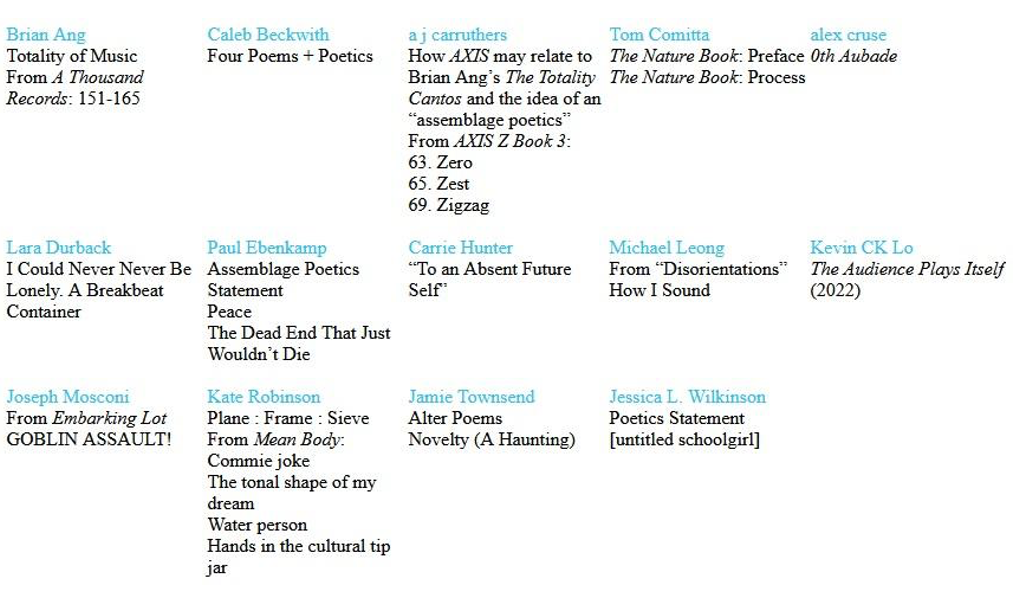
Assemblage Sampler, ed. Brian Ang (2023), contents
To develop assemblage poetics further, I edited Assemblage Sampler asking those I analyzed in “Assemblage Poetics” to contribute and each bring in another person to continue constituting assemblage poetics, my intention being to decenter my editorial authority. The resulting contributors were me, Caleb Beckwith, a j carruthers, Tom Comitta, alex cruse, Lara Durback, Paul Ebenkamp, Carrie Hunter, Michael Leong, Kevin CK Lo, Joseph Mosconi, Kate Robinson, Jamie Townsend, and Jessica L. Wilkinson. Assemblage Sampler announced ASSEMBLAGE, my new publication to continue constituting assemblage poetics. My contribution was my first presentation from my current poetic project, “A Thousand Albums,” open to the totality of music, which commences a series of book-length poems called The Multiplicity Project. [47] Australian-born and writing from Nanjing, carruthers’ contribution offered a decentered perspective on totality and United States hegemony:
Ang’s impetus for the political thinking of totality is the 2008 financial crisis. It should be known that because I am not an American poet, it is only natural that I will have a different experience of the political and geopolitical approach to totality, and a different perspective on it…[T]here is no thinking of totality in our time without Empire and without thinking geopolitical materialism and the materiality of nations—not at all divorced from the question of classes. By Empire we mean the USAmerican Empire, and how its discourses, or probably more accurately, its ideologies—progressive or regressive—can permeate the globe in a flash…Perhaps there is a time when epicists will again join forces to be the producers of a truly multiaxial World Culture. And if that time is not now, then its time is to be, so in the meantime we are busy making these connections. [48]
Approaching my work through the concept of the avant-garde, David Lau offered both affirmation of The Totality Cantos, post-crisis poetics, and ARMED CELL and critique of assemblage poetics:
Ang posits totality as a series of discursive concepts, riotously jamming to each other. His Cantos develops a method out of our earlier shared concept of post-crisis poetics. Years after ceasing to publish his journal Armed Cell, Ang has created a mad superstructure of the polycrisis. Project books tend to delineate some social issue, “lived experience,” while Ang develops all the possible subjects of writing (!) if on an abstract, peak-overlooking-the-valley level replete with edgy Occupy politics…With Armed Cell and Totality Cantos in the rearview, he now advances an “Assemblage Poetics,” an immanent critique of his “militant” poetics of Occupy vintage. His new webzine and new poetics “project” that uses album and recording related discourse in estranging samplings, á la his Cantos, is more a semi-conventional “project” book. It has a topic. The tenting concept of “assemblage” is vast, even cliché. The examples of assemblage, faintly linked, disband the armed cell. “Assemblage” is informal solidarity, as Alex Cruse or Tom Comitta can each find their own way. One doesn’t turn a corner on a poetics of identity, as Totality Cantos had done. While his journal Armed Cell framed poetics in terms of Badiou’s injunction to seek a new militant subject, he has arrived at a new editorial project called Assemblage Poetics, which substitutes an aesthetic of formal openness for his previous dream of weapons. [49]
Assemblage poetics is not opposed to ARMED CELL, post-crisis poetics, and The Totality Cantos but rather extends them. A Thousand Albums has a topic, being open to the totality of music, but considered in its multiplicity constitutive of totality in general, continuing my desire in The Totality Cantos to be interested in everything through immanent investigation, applying the form and method of The Totality Cantos’ assemblage poetics specifically to the totality of music, constructing assemblages from music’s multiplicity toward apprehending totality in general. The Multiplicity Project’s immanent investigations of topics will continue apprehensions of the totality they constitute.
Assemblage poetics is decentered and multiaxial, drawing a smooth space of practices to which more critical practices may be connected, an assemblage of practices to apprehend totality and reassemble it otherwise, convicting it of nonidentity with itself. Assemblage poetics continues concerns with subjectivation in ARMED CELL, post-crisis poetics, and The Totality Cantos, including a militant one, aiming to shape subjective sense, possibilities for making meaning. Against totality’s organizations of power that define dominant, limiting forms of sense that constitute us as subjects, assemblage poetics assembles parts of totality against dominant forms toward counter-subjectivations, looking for new weapons everywhere.
In both constructing texts and social formations of practices, assemblage poetics emphasizes the assembling of multiplicities that ARMED CELL, post-crisis poetics, and The Totality Cantos did, a practical poetics considering how words and practices affect each other, how they may increase possibilities for making sense. To add to a j carruthers’ ideas about “epicists”—and others—“[joining] forces to be the producers of a truly multiaxial World Culture,” I see a continuing task to assemble a global critical poetics connecting critical discourses and practices dispersed in totality and traversing United States hegemony in order to construct assemblages to face contingencies and transformations both locally and globally, now and to come. [50]
See here for a complete list and notes and sources.