Imaginary Neighbors: Looking for Poetry in Western Massachusetts’ Connecticut River Valley
The neighbors rustle in and out—Emily Dickinson

When You Think of It Liner Note, 9/10/2009
The last poem I will ever write / will be like the first one I ever / wrote down—Matthew Zapruder
Chapbooks are stealth books…They can slip under a door…They are secret handshakes.—James Haug
I love chapbooks. They’re mostly small, don’t take up much space. Approachable. Easy to hold and to walk with. I have many. At one time I didn’t know a thing about chapbooks. I’d notice them but pay them little mind. I paid more attention to books.
I had inklings there was something curious about writers who lived and worked and passed through where I was born and raised, but I didn’t anticipate the extent of it.
One inkling led me to read James Tate’s poetry for its wit, sincerity, and vignettes of strange consequence—“Have you read any Emily Dickinson?”...“I reckon I’ve read all of her poems at least a dozen times.” As a young writer this was encouraging. I wanted to see what more I could find, of his, and of others.
In a neighboring meadow my neighbor wrestles with the grass. Soon, I left my hometown in western Massachusetts for New York City—to read, write, read and think about poetry, as much poetry as I could. I looked for poetry that pushed buttons and boundaries. I liked poetry that made me laugh, that surprised me. I looked for what could show me what was possible. I liked what didn’t sacrifice honesty and emotion for sentimental purposes. Every place has admirable things in it.
I went to poet Matthew Rohrer, asking him to recommend something weird and fierce. He suggested Mark Leidner’s Beauty Was The Case That They Gave Me. I found it to be out of print. I couldn’t find a used copy. Leidner’s first book remains elusive.
One summer afternoon in a small bookstore on the Bowery, I happened upon a handsome chapbook with blocky shapes on the cover—Christian Hawkey’s ULF, a bizarre space-odyssey long poem in which ULF is a character in the world but also the world itself. It’s challenging, playful, acerbic, a little brash. I am nearly eating the word sob. I loved it. I noticed its publisher, factory hollow press, also published Leidner’s book. I wanted to know more.
Here’s where my story becomes fanatical. Who are these writers? How do they write these poems?
Why here in this place? What do they know that I don’t know? I started searching for pieces of a river valley literary scene I knew nothing about. It was like dining at tables from which legs were taken. I needed to do something about this.
Whenever I’m back in Massachusetts, I have in mind to seek out specific poets or local publishers, looking and finding connections among them. One source that acted as a springboard is Amherst Books. Something notable about their poetry section is that it includes many titles by local poets or poets who’d passed through the area, many titles published by local, and locally-associated, small presses and journals. Slope Editions, Adastra Press, Magic Helicopter Press, Scram Press, issues of Conduit and Rain Taxi. Going through its stacks of poetry one day, I spotted Mark Leidner’s Beauty Was The Case That They Gave Me, at last. Its first poem, “The River”, ends—I still love the river, I told / her. But I do not love the river because it is deep, and fast, and drowns many people. / I love it because it runs behind my house, and I have lived above it forever. The collection is tender, bold, and full of conviction.
Other times, in Amherst Books, stashed in its wooden chapbook crate, I found all these poets I needed to find. Ish Klein, Jamie Thomson, Gillian Conoley, Lesle Lewis, Dorothea Lasky, Patty Gone, Kate Lindroos, Andrea Lawlor, Arisa White, Colleen Louise Barry, Lawrence Giffin, chapbooks from factory hollow press and Agnes Fox Press and The Chuckwagon. I became certain I had found the kinds of poetry I have always been looking for. I started searching for more chapbooks. The chapbooks, the poems, the poets were keeping me company.
I am learning how to be a person in this town
what’s the point of saying hello over again?
If it is true that I, you, don’t exist but we are in it / for the eternity.
Your idols are greased with napalm.
The horse is looking into me / from far away / with binoculars
The book in which your name is listed is out of print.
As my search went on, my methods expanded. I noticed a lot of the poets, beginning in the late 1990s, made use of blogs. Hannah Brooks-Motl and Mark Leidner wrote a blog called Poets on Film. There was Jono Tosch’s Oil Changes, a food blog that came with a subtitle “the anti food blog food blog;” a few other blogs included Weird Deer, In the Library with the Wrench, Wolf in a Field.
So many blogs. Often in conversation with each other, their links sent me to their friends’ blogs, poems, chapbooks, small publishing outfits, and books. Some sent me to print journals, Invisible Ear, Bateau, Model Homes, The Physical Poets, The President’s Choice, baffling combustions. The chapbooks and blogs share a do-it-yourself sensibility, punkish attitudes, grassroots enthusiasm, a homemade feel.
Maybe this homemade feel is what haunts used bookstores. Western Massachusetts is full of used bookstores. Unnameable Books, Raven Used Books, Odyssey Bookshop, Book Moon, Roundabout Books, Boswell’s Books, Bookends, Broadside Bookshop, Federal Street Books, Schoen Books, The Montague Bookmill—its motto is Books You Don’t Need In A Place You Can’t Find. These bookstores can be found. The approximate quadrant is 42.3251° N, 72.6412° W — 42.5879° N, 72.5994° W — 42.3732° N, 72.5199° W — 42.1487° N, 72.6079° W.
What would I know about poetry without Braincase Press and Nick Moudry’s To not be sad is the landscape, and Juliana Leslie’s The lovers were making commas outside of the garden? How would I know The Song Cave started as a chapbook press in Northampton, Massachusetts? What would I do without Fewer & Further Press and Pilot Books and Brave Men Books and Flowers & Cream? How would old copies of Skein have come into my life? Its plain manilla dossier folder with poems attached to the lateral metal clamps! How would I even know what a lateral metal clamp is? Would I have ever known?
If I had never known Joshua Bolton’s But dear men, I miss / the backgammon or Halie Theoharidies’ Oh sell my heart. I mean shatter my heart. I cannot be with you anymore. Heather Christle’s The night was like a shadow box / inside a mirror box or Rachel B. Glaser’s we weren’t scared that a hand would grab us from the sunset / we wanted a hand to grab us, Ben Estes’ There is a way of saying sun, pebble, rain, frog / raven, pond, lion, cigarette, or Lesley Yalen’s After life, every person experiences something.
And what about jubilat? Over the course of jubilat's two decades (2000–2021), the journal included poems, maps, reprints, interviews and conversations, collections of single writer’s epigraphs, artist portfolios, micrographs, erasures, inkblot and anagram pairings, poetry comics, indices, word association experiments, questionnaires, community theatre playscripts, sheet music, drawings, proverbs, reproductions of textile art, concrete poetry, Hölderlin’s daughter’s last will, excerpts of Pythagoras and Pliny the Elder and John Clare, musicological entries, field guides, photo-essays, selections from a centuries-old diary by Samuel Pepys, pictures of owls, Appearances of Eternal Presence, an unconventional Table of Contents and a vast digital archive—visual taxonomies of birds and rare insects, 19th-century dresses, floral mechanisms, ferns, paintings of houses, images of dogs, cats and wild animals, optical lanterns, excerpts from Christopher Smart, Paul Celan, Sappho, and the complete text of The Lost Epic of Arthur Davidson Ficke.
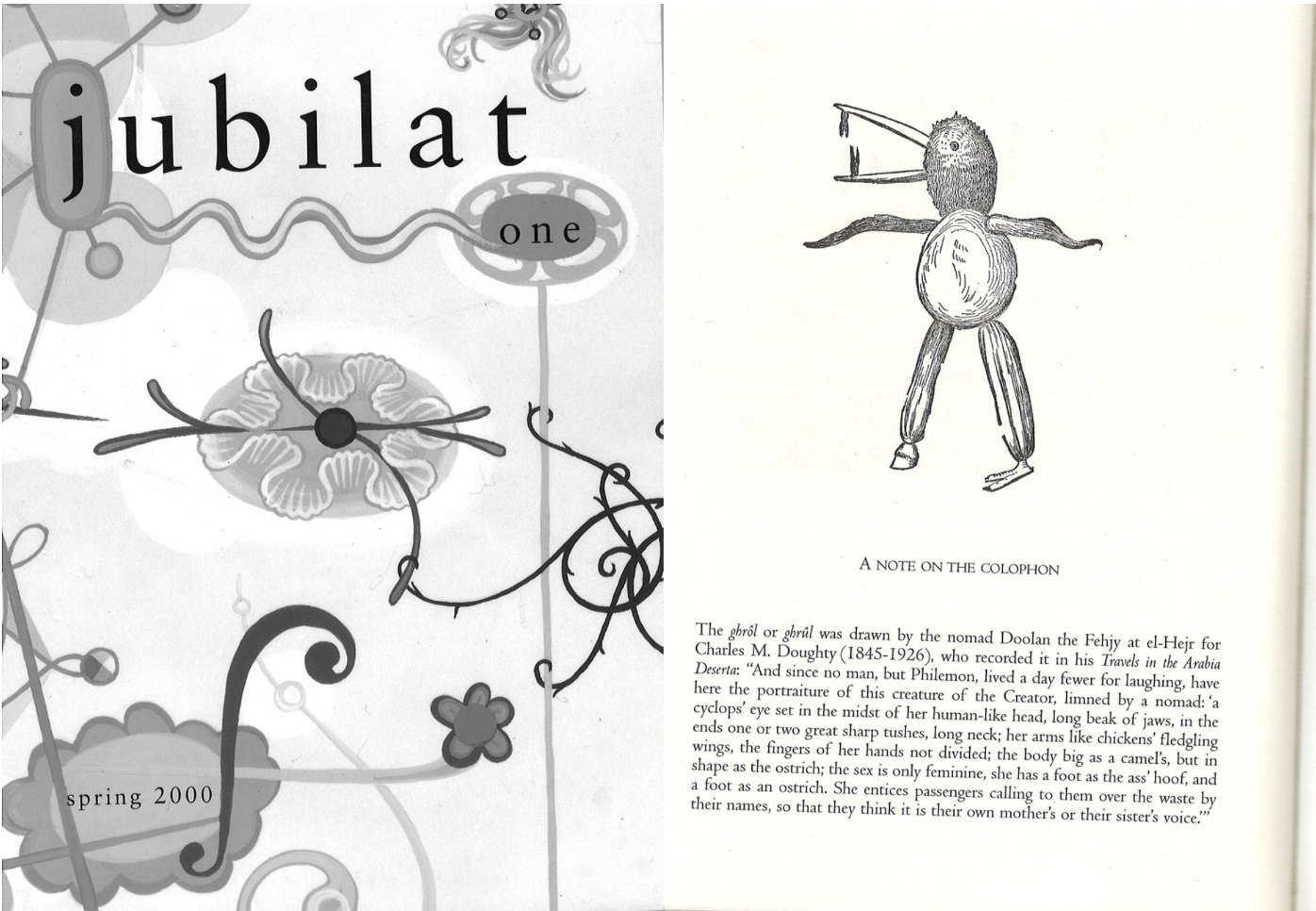
jubilat, #1, Original Cover Painting and Design, Jeff Hilliard, 2000
What about the times the poet James Haug sat with me on his porch, to share coffee and talk about writers and books, and chapbooks. He gave me treasure, once a scroll printed in 2015 at the closing of Flying Object listing its 246 readings, exhibits, installations, residencies, concerts, symposia, talks and gatherings. A few times I’ve come upon used books and chapbooks marked with a red stamp on their title page: “FLYING OBJECT XO XO.”
Relics of Flying Object. Flying Object brought poets from all over the world to western Massachusetts. In a conversation with poet Joshua Edwards, Flying Object’s founder Guy Pettit talks about Flying Object as “...a place to be together. Not for the sake of products or successful performance or publication but for the sake of filling our lives with experiences worthwhile and strange and maybe magical enough to remember them and the people who were there.” Flying Object produced ephemera, broadsides, posters, films, postcards, chapbooks, records and record sleeves.
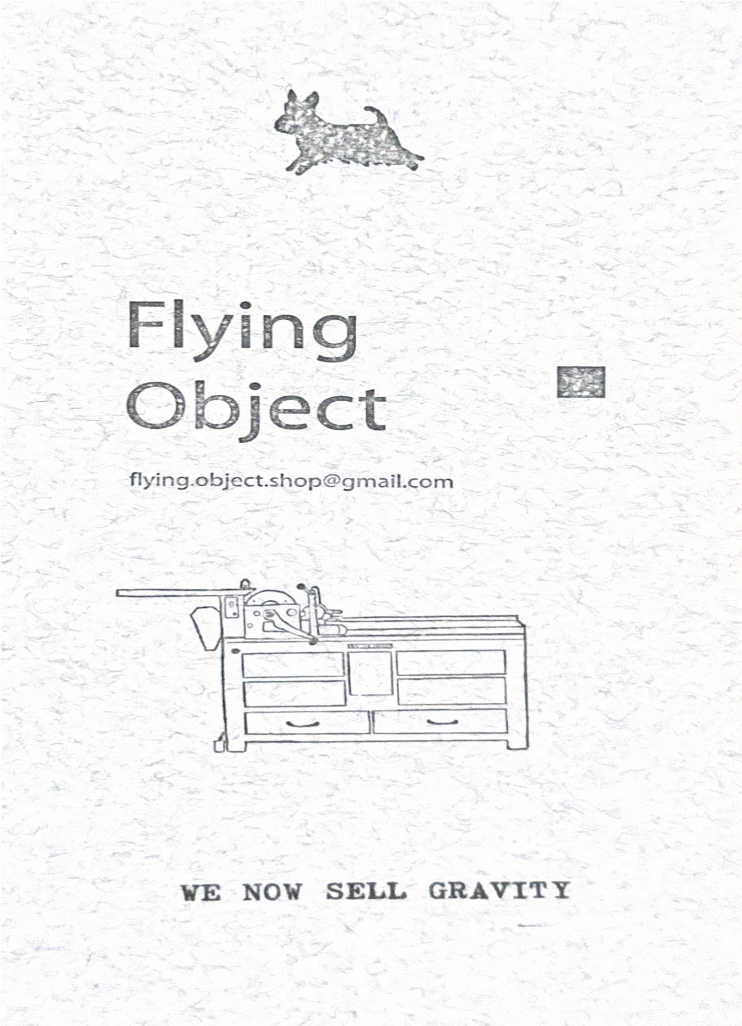
Broadside, Flying Object
I’d like in the next life to have most of the same attributes. When I think about everything I’ve found, I can’t help but want to name it…anaphora, anachronisms, parataxis, elisions and digressions, everyday beauty, considered and not overanalyzed, animals, And crickets everywhere in Kansas City and / Northampton, Massachusetts, shapes, They think its echo will make a triangle, colors, I feel the silver leaking through my feet, food, machines, knowledge that to live in the universe is to understand there are things we cannot know, a warmth and a forlorn essence, loneliness, characters who could be your neighbors or historical figures, public transport, going to bars, everyone has a friend in a band, or a few, or they are that friend in a band.
And I can’t leave out the old books, science fiction and extraterrestrials, speculative literature, board games and video games, cartoons and comics, the internet, theater of the absurd, weird dreaming, Nine people are writing the definitive book on it. Crate digging, persona, prose poetry, collage, good and bad movies, offbeat Americana, childhood, small cities and towns, little mountains, barns, rivers.
The uncanny, horrific, gothic, scary, domestic, quotidian misdirection, exuberance in play. What cannot be found, or what we find while we’re trying to find what cannot be found.
It’s tempting to want these poets to be part of a school or a scene, but it isn’t right. The writing is too varied. Many of the writers have come to western Massachusetts from other places. Birds from other area codes / sang their Precambrian songs. Ultimately, some stay, some leave. They all bring something with them, and those things stay.
I like to imagine poets in their everyday lives. What books have they read lately, or would like to read soon? What times of day might they write, or go to the grocery store? Do they write sitting down, or standing up, maybe walking? Which roads do they prefer to take from Amherst to Easthampton? What do they do with their friends on weekends? What farm stands do they buy corn from? What movies do they watch? What bands do they go see? Where’s their favorite place to be when it’s a pretty, sunny day? every brick every house every crumb every dust / every fiber every blood every mountain every snow / every tree every life every valley every chasm.
What does this matter to me or anyone else? Why all the interest in poets’ private lives? Should I not be? It seems that I am no matter what. Why does anyone want to see how other people live? If I knew where Fernando Pessoa bought groceries or ate a sandwich on his lunch break as a foreign correspondent for commercial establishments, what would I learn about his poetry? Why has all of my looking for chapbooks and books and poems, and the connections among people who passed in and out, led me to imagine what they do everyday? Is it that we want to find some piece of ourselves in them and in what they do, when what they do is something someone else might hope to do themselves? Is it possible to live other lives?
Everywhere you go will be somewhere / you’ve never been.— Natasha Tretheway
In those years I lived / happily ever after. And still do.—Agha Shahid Ali
In Order of Appearance:
Luke Bloomfield, Emily Pettit, and Guy Pettit, “Dear Reader.”, When You Think of It, notnostrums, 2009
“Have you read any Emily Dickinson?”...“I reckon I’ve read all of her poems at least a dozen times”
James Tate, “Of Whom Am I Afraid”, Return to the City of White Donkeys, Ecco, 2004
“In a neighboring meadow my neighbor wrestles with the grass”
Michael Earl Craig, “Lamp”, Can You Relax In My House, Fence Books, 2002
“Every place has admirable things in it”
Emily Bludworth de Barrios, “sure you do not suspect me of not feeling”, Splendor, H_NGM_N Books, 2015
“I am nearly eating the word sob”
Christian Hawkey, ULF, factory hollow press, 2010
“It was like dining at tables from which legs were taken”
Emily Toder, “Investigations with Bee Colonies from Which the Queens Are Taken”, The Conduct of Bees in the Buckwheat Season (anthol.), factory hollow press, 2007
“I am learning how to be a person in this town”
Jamie Thomson, “Carousel”, Possibilityism, factory hollow press, 2021
“what’s the point of saying hello over again?”
Arisa White, “Disposition For Shininess”, Disposition For Shininess, factory hollow press, 2008
“If it is true that I, you, don’t exist but we are in it / for the eternity.”
Gillian Conoley, “The Long Marriage”, jubilat, #26, 2014
“Your idols are greased with napalm.”
Dorothea Lasky, “Shrine-niche, and Bishop’s Hat” baffling combustions, #1, No Date
“The horse is looking into me / from far away / with binoculars”
Jeannie Hoag, “The Horse Is Looking Into Me”, New Age of Ferociousness, Agnes Fox Press, 2010
“The book in which your name is listed is out of print.”
Lesle Lewis, “The Earth Has Broken”, It’s Rothko in Winter or Belgium, factory hollow press, No Date
“I’d like in the next life to have most of the same attributes.”
Jack Christian, “Domestic Yoga”, Domestic Yoga, Groundhog Poetry Press, 2016
“And crickets everywhere in Kansas City and / Northampton, Massachusetts”
Seth Landman, “Appeal”, UMMMMM THE MIND, Chestnut Press, 2019
“They think its echo will make a triangle”
Eric Baus, “Something else the music was”, Something Else the Music Was, Braincase Press, 2004
“I feel the silver leaking through my feet”
Monica Fambrough, Meta Parka, Weird Deer, No Date
“Nine people are writing the definitive book on it.”
Brian Henry, “Insomnia”, Astronaut, Carnegie Mellon University Press, 2002
“Birds from other area codes / sang their Precambrian songs”
David Berman, “Narrated by a Committee”, Actual Air, 1999, Open City
“every brick every house every crumb every dust / every fiber every blood every mountain every snow / every tree every life every valley every chasm”
Tomaž Šalamun, “Who’s Who”, Kiss the Eyes of Peace (transl. Brian Henry), Milkweed Editions, 2024
See here for a complete Works Cited.