“fathoms five”: Susan Howe’s Penitential Cries
Susan Howe. Penitential Cries. New York: New Directions, 2025. 96 pages.
—“our father lies full fifty fathoms five a storm is coming”
Susan Howe’s Penitential Cries takes a deep dive into the existential core of her life experience and poetic wisdom, reckoning with legacies of trauma (personal, cultural, and literary), seeking transcendence through her collection’s bracing lyricism, ecstatic prose, and regenerative collage poems. In the spirit of her poetic ancestors and their resonant works (such as Shakespeare’s Tempest, H.D.’s “Eurydice,” and Hart Crane’s “Voyages,” among many others invoked in these pages), Howe’s resilient sequential forms lead us downward, respectively, “full fifty fathoms five” (23) into the underworld that “‘must open like a red rose / for the dead to pass’” (20), following the “‘Imaged Word … that holds / Hushed willows anchored in its glow’” (85). Her elegiac stichomancy and factual telepathy transmit “ecstasies of exactness” (14) from the depths, emerging “by dawn’s occult twilight” (15) at the top “of the steep hill covered in sand we must all climb to reach the lost family fable” (24). Susan Howe’s Penitential Cries is a fierce and tender resource for hope through dark times at late hours in the “Evening of life” (83).
This is Howe’s fifteenth book from New Directions (since The Nonconformist’s Memorial, 1993) following kindred volumes (most recently Concordance, 2020) that combine hybrid sequences of historical contexts, lyrical poetry, visionary prose, and inter-/intra-textual collage poems. Howe arranges Penitential Cries into four parts (“Penitential Cries,” “Sterling Park in the Dark,” “The Deserted Shelf,” and “Chipping Sparrow”) the first and third of which combine poetry and prose. “Penitential Cries” (the book’s first section) opens with an untitled poem followed by four hybrid sequences: “Widows and Pariahs 1,” “Widows and Pariahs 2,” “Widows and Pariahs 3,” and “Experience.” “The Deserted Shelf” (the third section) opens with an untitled prose poem followed by an “Epilogue.” “Sterling Park in the Dark” presents a sequence of forty-eight collage poems/stichomantic nests; and “Chipping Sparrow” (dedicated to Fanny Howe) includes three pages of meditative poetry (in the spirit of the volume’s grounding in early modern devotional verse, such as that of Sir Thomas Wyatt, whose sonnets inform at least three of the book’s collage poems (52, 53, 54) as well as Howe’s reflections upon her work in this volume: “My galley, charged with forgetfulness, / through sharp seas in winter nights doth pass”). The book also includes three images: the front cover’s vivid adaptation of a foreboding image from Emily Dickinson’s 1859 letter to Susan Gilbert Dickinson; a black and white photograph of a sailboat (in the midst of the collage poems); and a devotional image/text (“My Book and Heart / Must never part”) that concludes “Epilogue.” The volume also includes the publisher’s page, which notes that “Widows and Pariahs 2” was previously published (appearing in The Paris Review), and concludes with “End Notes” that lists the previous publication of portions of “Sterling Park in the Dark” in Bricks from the Kiln vol. 7 (2024) and documents many of the numerous contextual materials (historical and literary) that shape Howe’s research and creative/critical methods throughout the book. (In that regard, dedicated readers will recognize the familiar co-presence of many of Howe’s kindred spirits, such as Jean Cocteau, H.D., Wallace Stevens, Sarah Pierpont Edwards, John Donne, and Emily Dickinson (among others) alongside the co-presence of several historical and/or literary figures specific to this volume (Marguerite Porete, Catherine Sloper, Alvin Lucier, Lady Honoria Dedlock, Mary of Clopas, and William Blake (among others).)
Penitential Cries (96 pages) is a more compact volume compared with That This (2010), Debths (2017), and Concordance (2020), although not as brief as Spontaneous Particulars (2014, 79 pages); Howe’s distillation of lyrical sequences, prose poems, and inter-/intra-textual palimpsests in this new volume emulates the work’s deep dive (katabasis) over “the brink of afterlife or nothing” (9) “even if we are dead and even if there is nothing in the tomb” (24). In the spirit of Debths, Howe listens closely to messages from the other side(s) of the tomb, acousmatically “transmitting chthonic echo-signals” (11) that she collages into prose poem sequences in Penitential Cries inflected and illuminated by spontaneous telepathic particulars “scattering stars across a field running parallel with eternity the truth of quietness before birth of the world we need to run across to ask if nomen has other omens when each lost letter speaks for itself” (16). Compared with Howe’s NDP volumes since Souls of the Labadie Tract (2007), for example, in this new collection Howe turns her chthonic echo-signal stethoscope more closely upon herself than ever before, documenting her daily bouts with tachycardia—“Each morning rapid heartbeat. Scattered alphabet” (9)—that modulate into the more consistent measures of her “still beating heart tell all” (11) and her “Heart pictograph little frills” (25), which (in one memorable line) transpose the echocardiogram’s visualization into the variable music of her palpitations tuning from pitch to pitch: “Mitral tremolo sliding glissandi chaff” (25). In several instances such as this, Howe abruptly undercuts her lyrical resonance (“glissandi chaff”) with a widow-pariah’s acerbic riposte: “There remains a root of bitterness in the best hypocrites” (10); “I have wept away all my brain” (11); “Body as empty shell … whishth chipping” (90 – 91). Another sarcastic refrain running through this collection concerns Howe’s frustrations with the health care system: “Don’t worry. You have met your deductible and can check in at one of our Welcome Kiosks before headlong drop to earth whether gold or no” (12); “I didn’t see a memory test for octogenarian pariahs coming and yes I admit the fact that I failed this first one is a bad sign but if only you had asked me to repeat ‘unanswered perilous, question’ after counting down from 47 backward in increments of seven ….” (16). Howe’s playfulness transforms these reflections upon her own vulnerability into conversational humor.
Penitential Cries is also a book of dreamwork through which Howe communicates with her former husband, David von Schlegell (11); her mother, Mary Manning Howe Adams (23); and her father, Mark De Wolfe Howe (79) in addition to connecting telepathically with several kindred literary ancestors and Christian mystics (as noted above), especially H.D. and Eurydice (12, 18, 19, 20, 61, 83), Marguerite Porete (15), Sarah Pierpont Edwards (18), John Donne (20, 22), Mary of Clopas (84), and Hart Crane (85) among others. Howe’s keen interests here concerning H.D.’s “Eurydice” circle back to 2023, when she contributed to a performance of Alvin Lucier’s “So You … (Hermes, Orpheus, Eurydice)” with Anthony Burr, Charles Curtis, and Jessika Kenney on March 11th at Amant in Brooklyn. Earlier that year, Howe’s longstanding devotion to the writings of Sarah Pierpont Edwards was sparked anew by her colleagues at Yale (Catherine Berkus, Kenneth Minkema, and Harry Stout) who introduced her to recently encountered manuscripts from the Edwards Family archives at the Beinecke Library.
Libraries, archives, manuscripts, and books always contribute significantly to Howe’s research contexts, creative and critical methods, publications and performances, and this is certainly true for Penitential Cries in which the Sterling Library at Yale plays a central role for Howe’s telepathic quantum quests (18, 19, 20, 21, 22, 86):
“I’m sifting for sterling particles, delight of the hunt. Sometimes afternoon sun filters through tercet bone-dust, allophonic dust, pastoral watermark teething all here—all about the heart. The history of the world, a heap of refuse books, captivity, moments of birth and beauty, penitence, promiscuity, etc. One wise pariah of the mystic class going under the name of Spiritual peeps through an upper tower window-sliver into the center of the Starr Reading Room far below. She has left the metaphysical field as her work is not religious. Only an empty shell” (22).
This passage in particular echoes Howe’s ardent reflections in “Personal Narrative” (from Souls of the Labadie Tract) upon her early visits to the Sterling Library (during the 1970s and 1980s) when she “felt the spiritual and solitary freedom of an inexorable order only chance creates” and where in “Sterling’s sleeping wilderness [she] felt the telepathic solicitation of innumerable phantoms” (14).
Compared with her recent volumes that have included sequences of collage poems (Souls, That This, Spontaneous, Debths, and Concordance), this new volume introduces a distinctive gesture that frames Howe’s nested inter-/intra-textual stichomancy in a new way. Souls introduced Howe’s collage poems as embodiments of textiles (inspired by the fragment of the wedding dress of Sarah Pierpont Edwards). That This and Spontaneous Particulars transformed Howe’s collage poems into telepathic transcriptions (“Hannah doves”) from the diary of Hannah Edwards Wetmore. Debths curated the collage poems in “TOM TIT TOT” as a gallery installation of facing pages (recalling their first public appearance in 2013 at the Yale Union gallery in Portland, OR). And Concordance sequences Howe’s collage poems in baroque choral arrangements emulating her studio and field recordings (2021) with David Grubbs.
In her remarks accompanying a 2015 exhibit of her artist books at the University of Denver, Howe reflected upon some of these differentiations: “TOM TIT TOT broke my poetry, opened a new path to follow that began with the poems in Frolic Architecture and has been encouraged in acoustic directions while working on collaborations with the musician and composer, David Grubbs. I still felt somehow that Frolic was anchored-down to some material, a document or fact—to Hannah Edwards’s original text—whereas TOM TIT TOT tosses chance and discipline together in a more kaleidoscopic way” (Howard, 2015). In a 2021 Zoom conversation with Grubbs and David Bernabo, Howe describes her methods of preparing for the 2019 Grenfell artist book edition of Concordance, assembling the collage poems via stichomancy and splicing during her visits to NYC: she would scan, print, and cut up reproduced passages from “an enormous collection of nature books from all over the world” that she found at a loft she was renting, as well as passages from scanned prints “from old Concordances [she had previously] found while roaming the stacks at [Yale’s] Sterling Library in New Haven [… cutting] words and bits of sentences from the xerox copies [taping] them to a page in various ways then [running] the result through a copier again.” Howe would then continue the process with Leslie Miller, scanning her “pasteups” to prepare them for high-resolution digital images, which would form the basis for the photopolymer plates that Miller would later prepare for letterpress printing at Grenfell. Howe tells Bernabo that this collaborative process of assembling palimpsestic inter-/intra-texts was “repetitive, rather rigid, but wonderful in the sense of chance and telepathy,” and likens the resulting collage poems to field recordings and watercolors.
In each of these collections (Souls, That This, Spontaneous, Debths, and Concordance), Howe’s collage poems embody themes and methods central to each work’s occasion(s) and subject(s). Penitential Cries sets forth a sequence of forty-eight stichomantic nests under the title of “Sterling Park in the Dark” that suggests a landscape of inter-/intra-textual sculptural installations, such as these facing pages (from pages 52 and 53):

Howe’s various source texts (some of which she identifies in the book’s concluding notes) include selections from Goethe’s scientific writings, Ovid’s Metamorphoses, Emily Brontë’s Wuthering Heights, Robert Louis Stevenson’s poems, the letters of Henry James, and (as is the case in these above facing pages) Sir Thomas Wyatt’s poems (52 – 53, and 54). All of Howe’s source texts for the collage poems are in the public domain, and many may be found in electronic editions via the web.
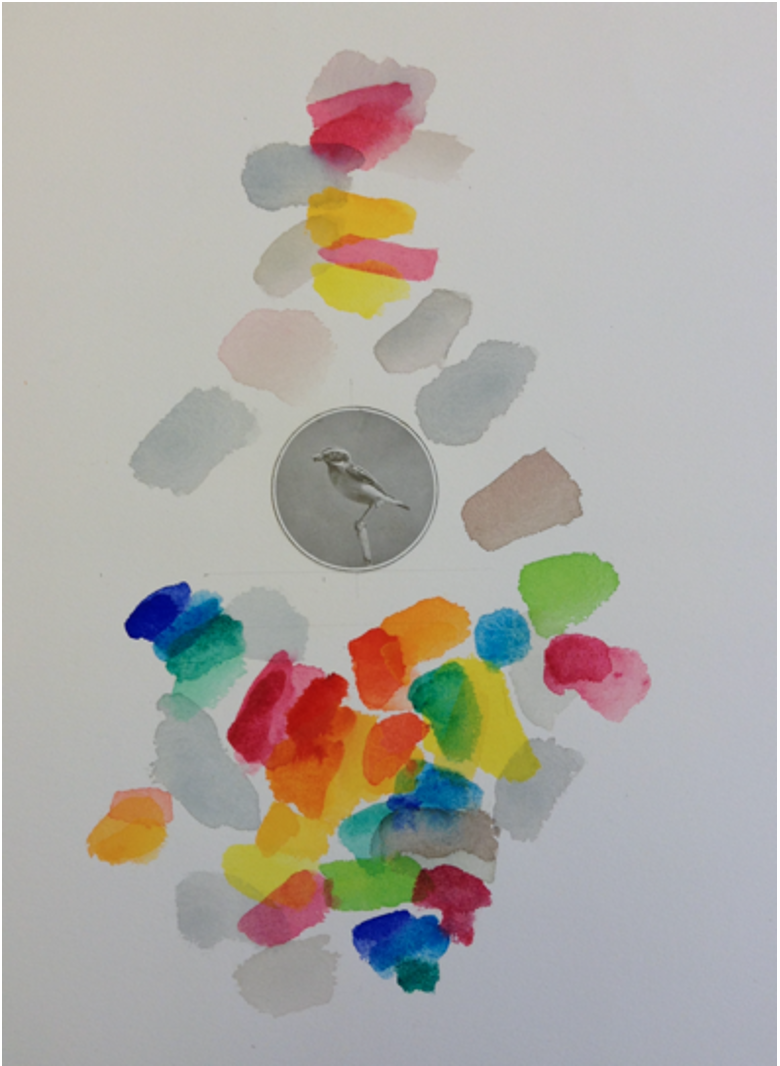
Some of the most poignant moments in Penitential Cries invoke birds—“Enjambment tipped in with wings extended” (10), “Miles away as the crow flies” (11), “watch bird nest” (12), “Noah’s dove returns not” (18)—including this striking self-reflective passage set within the Sterling Library: “A dove for the Shaping spirit of Imagination beats her wings against two thousand tons of steel and iron built on early twentieth century skyscraper principles to hold sixteen miles of aisles with carrell partitions at windows” (86). The innumerable birds in Susan Howe’s works since the 1960s are “tender, tangled, violent, august, and infinitely various” (59) especially in Spontaneous Particulars, where there are doves, falcons, nightingales, teals, “winged Sesames” (78) among others lost or found, and one glorious swan. Howe’s birds in Penitential Cries, although more seldom seen, carry her back across the decades to her early bird drawings and watercolors at the Beinecke Library: “Watercolor pencil series thirty-six colors pale to grey hidden / watercolor brush under the lid” (9).
“Special visitors
Walking on stilts
in snow” (90).
Walking on stilts
in snow” (90).
Works Cited
Primary:
Howe, Susan. Penitential Cries. New York: New Directions, 2025.
—. Debths. New York: New Directions, 2017.
—. Spontaneous Particulars: The Telepathy of Archives. New York: New Directions, 2014.
—. Souls of the Labadie Tract. New York: New Directions, 2007.
Contextual:
Bernabo, David. “Every single mark that you make on paper is an acoustic mark: an interview with Susan Howe and David Grubbs.” Medium (5 September 2021).
Howard, W. Scott. “‘windblown leaves’: acousmatic architectures & synesthetic soundscapes in Susan Howe’s Concordance.” Word For/Word: a journal of new writing 40 (2023).
—. Archive and Artifact: Susan Howe’s Factual Telepathy. Greenfield, MA: Talisman House, 2019.
—. “‘TANGIBLE THINGS / Out of a stark oblivion’: Spellbinding TOM TIT TOT.” Special Collections Showcase. University Libraries, University of Denver (5 August 2015).
Acknowledgements: Deepest thanks to Susan Howe for
permission to include an image from her watercolor bird collages at the Beinecke Library,
Yale University.